
Publish Date: March 2, 2026
Researchers Develop a Hybrid Physics-AI Framework for National-Scale River Flow Modeling | राष्ट्रीय स्तर पर नदी प्रवाह मॉडलिंग के लिए शोधकर्ताओं ने विकसित किया हाइब्रिड फिजिक्स–AI फ्रेमवर्क
Share this on
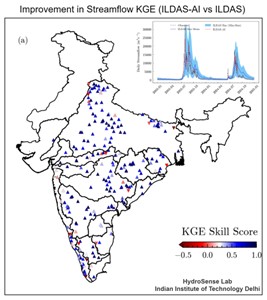
New Delhi: Researchers at IIT Delhi have developed India’s first national AI-enhanced river flow modeling system that significantly improves the accuracy of river streamflow predictions across the country, a critical advancement for flood forecasting and water resource management.
Published in the prestigious journal Water Resources Research (https://doi.org/10.1029/2024WR039792), the study led by PhD Scholar Bhanu Magotra and Prof. Manabendra Saharia from IIT Delhi's Department of Civil and Environmental Engineering and Yardi School of Artificial Intelligence demonstrates how integrating artificial intelligence with traditional hydrological models can overcome longstanding challenges in water cycle prediction.
Accurate river flow information is critical for water resources management, including irrigation scheduling, flood risk reduction, and reservoir operations. However, large-scale hydrological models often produce significant uncertainties in streamflow estimates at local scales unless extensive basin-specific calibration is performed. Such calibration is computationally expensive and challenging to implement across a country as hydrologically diverse as India.
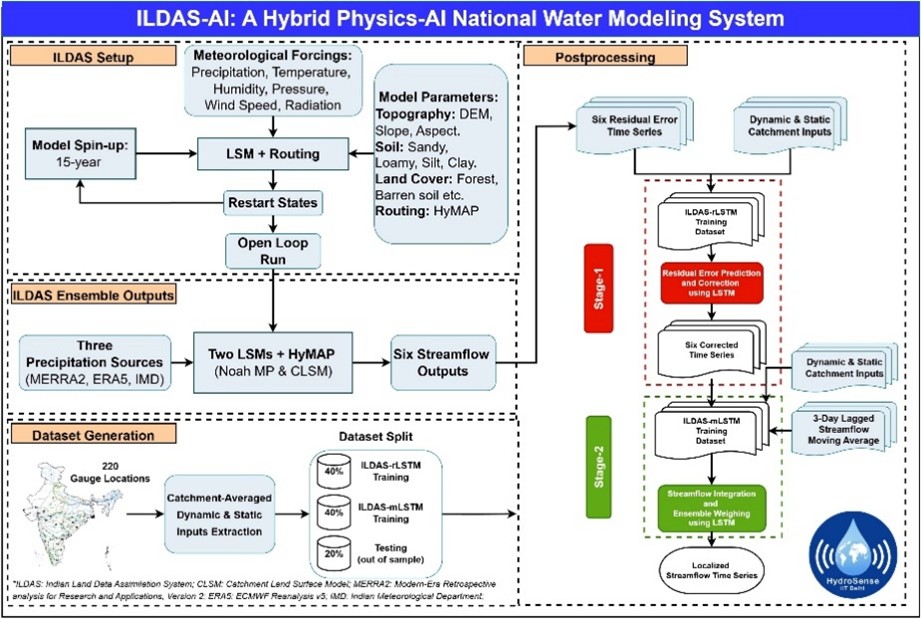
Addressing this challenge, the IIT Delhi team developed a novel integrated framework that combines the physical consistency of land surface models with the computational efficiency of Artificial Intelligence (AI). The system employs a two-stage Long Short-Term Memory (LSTM) neural networks, a type of AI particularly effective at recognizing patterns over time, to systematically correct river streamflow from the Indian Land Data Assimilation System (ILDAS). The AI model was trained on decades of streamflow data from hundreds of river gauge stations across India maintained by the Central Water Commission (CWC) under the Ministry of Jal Shakti.
By training on multi-decadal data and incorporating 27 different meteorological and geophysical attributes, the LSTM models learned to account for complex local conditions that traditional models struggle to represent. The model improved daily river flow predictions in nearly 95% of the basins, raising the national median value of Kling Gupta efficiency (KGE) from 0.13 to 0.60. Post-monsoon performance improved by 81.7% in error reduction, while flood peak predictions became 25% more accurate in both timing and magnitude.
The model was developed on IIT Delhi’s supercomputer. The research is particularly notable for its handling of India's hydrologically diverse catchments, which include heavily regulated rivers with reservoirs, arid regions, and monsoon-dominated basins.
This work presents a significant step forward in integrating traditional hydrological science with modern artificial intelligence. This technology can be used to develop river basin digital twins, supporting informed decision making in India.
******
नई दिल्ली: आई.आई.टी. दिल्ली के शोधकर्ताओं ने भारत की पहली राष्ट्रीय ए.आई.-संवर्धित नदी प्रवाह मॉडलिंग प्रणाली विकसित की है जो देश भर में नदी प्रवाह के अनुमानों की सटीकता में काफ़ी सुधार करती है। यह बाढ़ पूर्वानुमान और जल संसाधन प्रबंधन के लिए एक महत्वपूर्ण प्रगति है।
आई.आई.टी. दिल्ली के सिविल और पर्यावरणीय इंजीनियरी विभाग और यार्डी कृत्रिम बौद्धिकता स्कूल के पीएच.डी. शोधार्थी भानु मागोत्रा और प्रो. मानबेंद्र सहारिया के नेतृत्व में किया गया यह अध्ययन प्रतिष्ठित जर्नल 'वाटर रिसोर्स रिसर्च' में प्रकाशित (https://doi.org/10.1029/2024WR039792) हुआ है। यह शोध दर्शाता है कि पारंपरिक हाइड्रोलॉजिकल मॉडल के साथ कृत्रिम बुद्धिमत्ता को एकीकृत करके जलचक्र पूर्वानुमान में लंबे समय से चली आ रही चुनौतियों को कैसे दूर किया जा सकता है।
जल संसाधन प्रबंधन के लिए नदी प्रवाह की सटीक जानकारी महत्वपूर्ण है, जिसमें सिंचाई समय-निर्धारण, बाढ़ जोखिम में कमी और जलाशय संचालन शामिल हैं। हालांकि, बड़े पैमाने पर हाइड्रोलॉजिकल मॉडल अक्सर स्थानीय पैमाने पर स्ट्रीमफ्लो आकलन में काफी अनिश्चितता पैदा करते हैं, जब तक कि बड़े पैमाने पर बेसिन-स्पेसिफिक कैलिब्रेशन न किया जाए। ऐसा कैलिब्रेशन कम्प्यूटेशनल रूप से महंगा है और भारत जैसे हाइड्रोलॉजिकल रूप से विविधता वाले देश में इसे लागू करना चुनौतीपूर्ण है।
इस चुनौती का सामना करते हुए आई.आई.टी. दिल्ली की टीम ने एक नया एकीकृत ढांचा विकसित किया है, जो ज़मीन की सतह के मॉडल की भौतिक स्थिरता को कृत्रिम बुद्धिमत्ता (ए.आई.) की कम्प्यूटेशनल दक्षता के साथ जोड़ता है। यह प्रणाली दो-चरण वाले लॉन्ग शॉर्ट-टर्म मेमोरी (LSTM) न्यूरल नेटवर्क का इस्तेमाल करती है, जो समय के साथ पैटर्न पहचानने में विशेष रूप से प्रभावी एक प्रकार की ए.आई. तकनीक है, ताकि इंडियन लैंड डेटा असिमिलेशन सिस्टम (ILDAS) से प्राप्त नदी प्रवाह आंकड़ों का व्यवस्थित रूप से संशोधित। ए.आई. मॉडल को भारत के विभिन्न भागों में स्थित सैकड़ों नदी मापन (गेज) स्टेशनों से प्राप्त दशकों के प्रवाह आंकड़ों के आधार पर प्रशिक्षित किया गया, जिनका संचालन एवं अनुरक्षण जल शक्ति मंत्रालय के अधीन केंद्रीय जल आयोग (CWC) द्वारा किया जाता है।
कई दशकों के डेटा पर प्रशिक्षण और 27 विभिन्न मौसम संबंधी और भूभौतिकीय विशेषताओं को शामिल करके, LSTM मॉडल ने जटिल स्थानीय परिस्थितियों को समाहित करना सीखा, जिन्हें पारंपरिक मॉडल प्रायः प्रभावी रूप से प्रस्तुत नहीं कर पाते। इस मॉडल ने लगभग 95% बेसिनों में दैनिक नदी प्रवाह पूर्वानुमानों में सुधार किया, जिससे केलिंग गुप्ता दक्षता (के.जी.ई.) का राष्ट्रीय औसत मूल्य 0.13 से 0.60 तक बढ़ गया। मानसून के बाद के प्रदर्शन की त्रुटि में 81.7% की कमी आई , जबकि बाढ़ शिखर के समय और परिमाण दोनों के पूर्वानुमान में 25% अधिक सटीकता प्राप्त हुई।
यह मॉडल आई.आई.टी. दिल्ली के सुपरकंप्यूटर पर विकसित किया गया। यह शोध विशेष रूप से भारत के हाइड्रोलॉजिकल रूप से विविध जलग्रहण क्षेत्रों के लिए उल्लेखनीय है,जिनमें जलाशयों वाली नियंत्रित नदियाँ, शुष्क क्षेत्रों और मानसून-बहुल बेसिन शामिल हैं।
यह कार्य पारंपरिक हाइड्रोलॉजिकल विज्ञान को आधुनिक कृत्रिम बुद्धिमत्ता के साथ एकीकृत करने की दिशा में एक महत्वपूर्ण कदम है। इस तकनीक का उपयोग नदी बेसिन डिजिटल ट्विन्स विकसित करने के लिए किया जा सकता है, जो भारत में सोच-समझकर फैसले लेने में मदद करेगा।
Other News
IIT Delhi Researchers Demonstrate Quantum Entanglement Alongside Classical Data Over Optical Fiber
Read More
स्ट्रोक के बाद बोलने की समस्या के उपचार के लिए आई.आई.टी. दिल्ली, एम्स नई दिल्ली और आई.एच.बी.ए.एस. ने विकसित किया मेलोडिक इंटोनेशन थेरेपी (एम.आई.टी.) का पहला हिंदी संस्करण।
Read More
IIT Delhi, AIIMS New Delhi and IHBAS Develop First Hindi Version of Melodic Intonation Therapy (MIT) for Post-stroke Aphasia
Read More
IIT Delhi Researchers Developing a High-Efficiency AC Capable of Reducing Electricity Use by a Third | आई.आई.टी. दिल्ली के शोधार्थी कर रहे हैं बिजली-बचत वाला स्मार्ट एयर कंडीशनर विकसित
Read More
आई.आई.टी. दिल्ली के शोधकर्ताओं द्वारा मानव वैज्ञानिकों की तरह वास्तविक वैज्ञानिक प्रयोग कर सकने वाले कृत्रिम एजेंट 'AILA' का निर्माण | IIT Delhi Researchers Create AI-Agent ‘AILA’ That Can Conduct Real Scientific Experiments Like Human Scientists
Read More
आई.आई.टी. दिल्ली और एम्स के शोधकर्ताओं ने किया एक निगलने योग्य सूक्ष्म उपकरण विकसित | IIT Delhi and AIIMS Researchers Develop a Swallowable Microdevice That Can Collect Microbial Samples from the Small Intestine
Read More
आईआईटी दिल्ली अध्ययन: एंड्रॉइड ऐप्स से निजी जानकारी उजागर होने का खतरा | Mobile Apps on Android Devices Requiring Precise Location Permissions Can Reveal a Significant Amount of Private Information About Users: Shows IIT Delhi Study
Read More
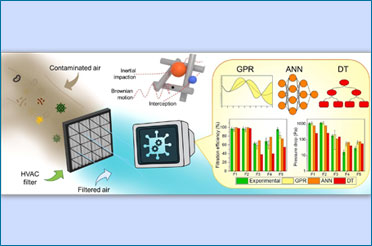
स्वच्छ इनडोर हवा के लिए आईआईटी दिल्ली का स्मार्ट एचवीएसी समाधान | IIT Delhi Researcher-led Team Develops Machine Learning Framework to Design Smarter HVAC Filters to Ensure Healthier Indoor Air Quality
Read More
आई.आई.टी. दिल्ली के शोधार्थियों ने सीमेंट की त्वरित गुणवत्ता जांच के लिए किया एआई मॉडल विकसित | IIT Delhi Researchers Develop AI Models for Instantaneous Quality Check of Cement
Read More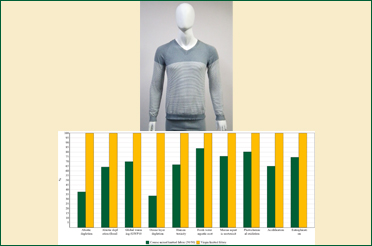
आई.आई.टी. दिल्ली के शोधार्थियों ने डेनिम अपशिष्ट को उच्च गुणवत्ता बनाए रखते हुए बुने हुए कपड़ों में पुनर्चक्रण की विधि की विकसित | IIT Delhi Researchers Develop Method to Recycle Denim Waste to Knitted Garments Without Compromising Quality
Read More
आई.आई.टी. दिल्ली के शोधकर्ताओं ने किया मच्छर रोधी डिटर्जेंट विकसित | Researchers at IIT Delhi developed Mosquito-repellent Detergents
Read More
Artificial Intelligence Transforming Meteorological Prediction Through Innovative Approaches, IIT Delhi Study Shows
Read More
Breakthrough at IIT Delhi: A Multifunctional Optoelectronic Computing Device (MOD-PC) for Next-Gen Neuromorphic Hardware
Read More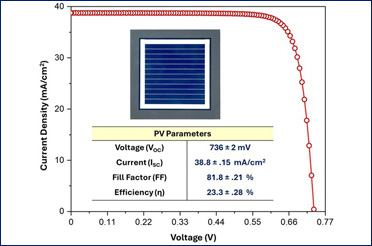
IIT Delhi Researchers Develop High-Efficiency Silicon Heterojunction (SHJ) Solar Cells with Power Conversion Efficiency of >23%
Read More
IIT Delhi Researchers Develop High-Speed, Self-Powered Photodetector for Next-Gen Optical Communication
Read More
Atomically thin graphene coating effectively protects glasses from simultaneous mechanical and chemical damage under water: Study
Read More
Sprayable Hydrogel by IIT Delhi Researchers for Improving Wound Healing Exhibits Promising Results in Pre-Clinical Trial
Read More