

Publish Date: January 2, 2026
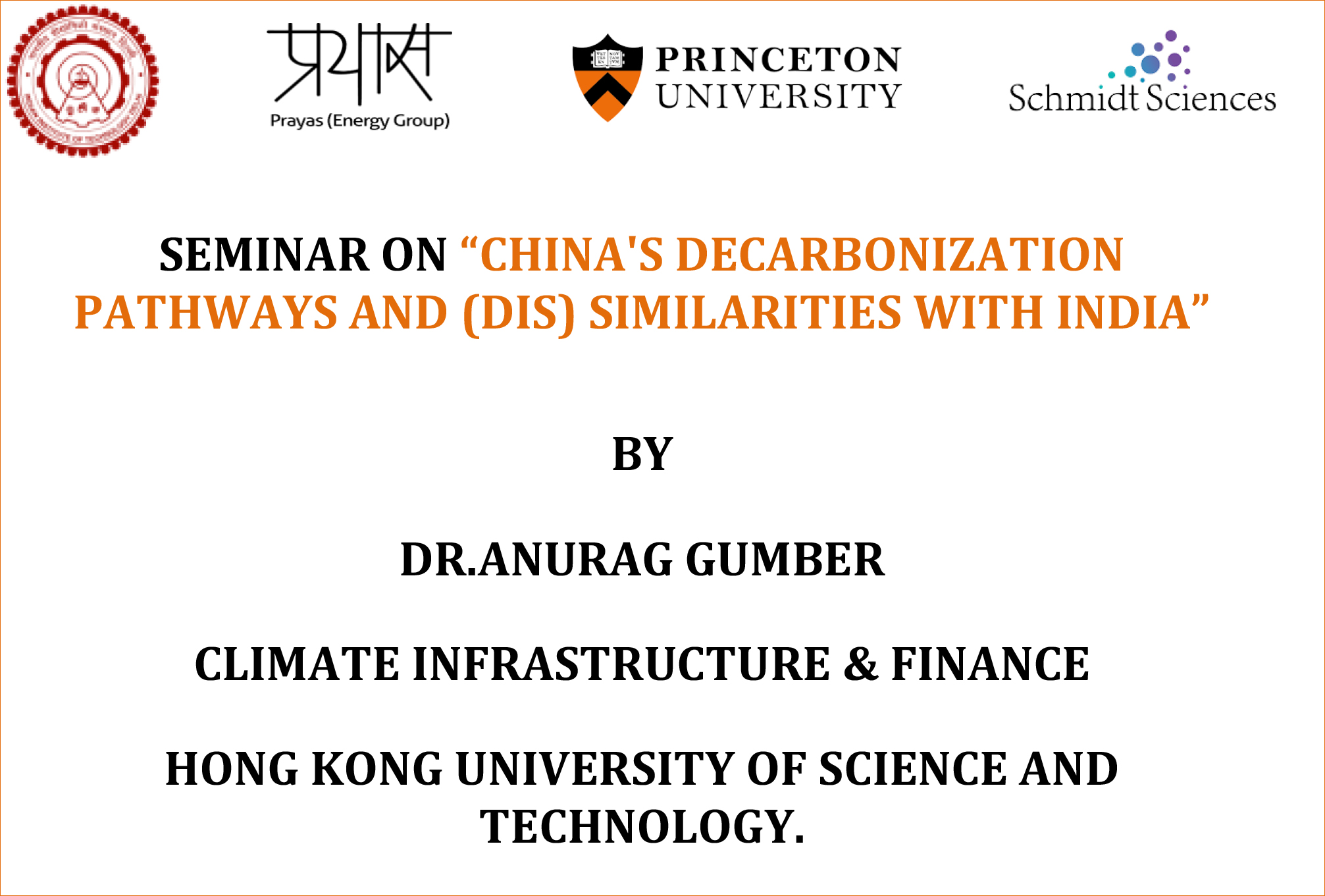
SEMINAR ON 'CHINA'S DECARBONIZATION PATHWAYS AND (DIS) SIMILARITIES WITH INDIA' BY DR.ANURAG GUMBER CLIMATE INFRASTRUCTURE & FINANCE HONG KONG UNIVERSITY OF SCIENCE AND TECHNOLOGY.
Share this on
Dear Students and Faculty Members,
We are pleased to invite you to Seminar on 'China's decarbonization pathways and (dis) similarities with India' , to be delivered by Dr. Anurag Gumber, Assistant Professor, Climate Infrastructure & Finance, Hong Kong University of Science and Technology.
We warmly encourage all students and faculty members to attend and participate in the discussion.
Kindly use this link to RSVP and let us know if you will be able to attend the session. https://forms.gle/UkgR6m9mt2occWWt7
Workshop Details:
Venue : LHC 527, Lecture Hall Complex, IIT Delhi
Date and Time : 7th January 2026, 14:30 - 17:30
**Tea and snacks will be served
About the Speaker:
Anurag Gumber is an Assistant Professor in Climate Infrastructure & Finance at the Hong Kong University of Science and Technology (Carbon Neutrality & Climate Change Thrust). He obtained his Ph.D. in climate policy and finance from ETH Zurich in 2024. He researches at the intersection of technology innovation, asset finance, and infrastructure development. His research investigates how low-carbon energy technologies mature from a financing point of view, how financial actors such as banks and institutional investors can increase investments to low-carbon projects, and how the development processes for building such low-carbon projects can be derisked. Prior to obtaining his Ph.D., Anurag worked in industry for over seven years advising several governments, development banks and infrastructure investors. He holds a Master's degree in Public Administration from Harvard University, a Bachelor's degree from Birla Institute of Technology & Science Pilani, and the CFA designation.
Abstract:
Despite leading renewable energy installations, China's energy sector investment is heavily skewed towards solar and wind. In this seminar, we will discuss a recent work from Climate Infrastructure and Finance Group at HKUST Guangzhou that analyzes investment requirements across models and scenarios to assess China's energy technology investment needs and choices. We will discuss the extraordinarily wide range of estimated capital needs among models and across scenarios, with China's low-carbon transition requiring average annual capital investment of $717 billion (55-3687), including USD 409 billion
(21-1715) in the energy technologies. We will also discuss the primary drivers of such variation and two distinct choices that China faces.
Namely, a more capital-intensive renewable-centric pathway that continues public and private over-investment in solar and wind but demands higher grid readiness investments. Or a lower capital nuclear-centric pathway that relies on dispatchable baseload generation with minimal integration-related costs but depends wholly on public investments and fiscal stability. At the end, we will make a comparison of India's choices with author's research.
For any queries, please contact: Ashwini Mudgal
(ashwinim.cstaff@iitd.ac.in) or Ekta Baranwal